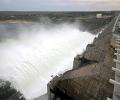
The Group of Ministers constituted for the creation of a separate state of Telangana on Wednesday discussed the sharing of river water and irrigation resources in Andhra Pradesh after the state's bifurcation, but failed to arrive at a resolution.
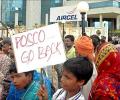
Is it inconsistency in policy, or the lack of robust support?

Downplaying concerns of delay, Amitabh Kant, managing director of Delhi-Mumbai Industrial Corridor Development Corporation (DMIC), says the project will be delivered on time.
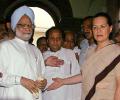
'While they were respectful of the PM, it was clear that as ministers, they owed their positions as much, if not more, to Mrs Gandhi.' 'When attacks were mounted on the PM, there was very little coordinated effort by the Congress, UPA ministers or other politicians to speak up in his favour and strongly defend him.' B K Chaturvedi, Cabinet Secretary during the early years of UPA1, reveals how the Manmohan Singh-Sonia Gandhi equation worked. A riveting excerpt from Chaturvedi's memoir, Challenges Of Governance: An Insider's View
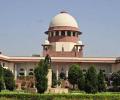
A Jharkhand court framed charges against accused through a WhatsApp call.
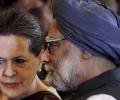
Three days after Rahul Gandhi's blunt attack against the ordinance on convicted lawmakers, Congress President Sonia Gandhi on Monday declared that the "whole party" stands behind Prime Minister Manmohan Singh.

The pro-SEZ lobby is claiming that the benefits of dam are going to be minimal for these villages as the irrigation department has already committed water for various other purposes. However, the anti-SEZ activists are claiming that enough water is still available in the dam to irrigate the land in 22 villages.

The Coal Ministry has decided to constitute a six-member panel for valuation and assessment of the 42 running coal blocks which were deallocated by the Supreme Court.

Singh also interacted with delegations representing different communities, including Kashmiri Pandits, Sikhs, Shias, Gujjars, Bakarwals and Paharis.
'The Constitution says the government, the council of ministers, shall be responsible to the House of the People which is the Lok Sabha, not to the Rajya Sabha.' 'Let us hope they will be able to show better floor and political management through a process of, if necessary, give and take.'

It has been said that by 2025, India could become among the top five economies in the world. If India does become a $5 trillion economy but gets all its rivers polluted, food chain poisoned and genetic pool depleted and biometric database of Indians sold or stolen at the behest of commercial czars, will it not be a pyrrhic economic victory, asks Gopal Krishna.
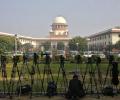
The 1995 judgment in the Union of India vs Cricket Association of Bengal case emphasised that free speech is essential for a successful democracy and citizens must have a plurality of views and a range of opinions on all public issues, says M J Antony.
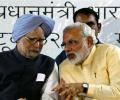
NDA under Mr Modi is as focused on the rural poor with doles and hand-outs as the UPA under Dr Singh was.

As the Modi government enters the fourth year of its tenure, it is looking more confident, shedding its earlier inhibitions about offering sops or new opportunities to big business, says A K Bhattacharya.
Not only is Modi's India not the shining land of dynamism and prosperity that he promised -- though it may be that, for some people, in a few years from now -- but socially it has the positively regressive tendencies that were entirely predictable.

Sonia Gandhi spends just 30 minutes in Kanyakumari to promote 39 candidates in Tamil Nadu. A Ganesh Nadar listens in.
.jpg)
Delayed clearances for coal blocks, as well as companies' own failure in developing mines, appear to have had a financial implication of Rs 1.46 lakh crore (Rs 1.46 trillion) for the country.
.jpg)
The year 2014 was one of the most challenging years for India. For two consecutive years our GDP growth was sub 5 per cent. Employment generation had declined, the revenue buoyancy was low and the country had become investment starved.

Few people know Ratan Tata as well as R K Krishna Kumar does. Widely perceived to be among the managers closest to Tata, Krishna Kumar assesses Ratan Tata, the man and business leader, in this exclusive interview to Rediff.com's Vaihayasi Pande Daniel.
'Mamata is synonymous with Bengal, its culture, language, traditions.'
The indebtedness of Indian companies has had an adverse impact on the economy's investment climate apart from weakening their performance and seriously impairing the financial health of the banking sector. Unless both the problems are resolved, there is little chance of reviving investment and boosting growth on a sustainable basis, says A K Bhattacharya.

'There has definitely been a breakthrough in the nuclear logjam. It is good to see nuclear energy back on the rails,' says Dr Anil Kakodkar, former chairman, Atomic Energy Commission.

Has the Modi government been more at odds with institutions than other governments? There is no doubt that there have been more run-ins. While the RBI and CBI cases have drawn attention, there have been others, less publicised, Subhomoy Bhattacharjee points out.
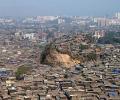
Though launched in 1996, the slum replacement scheme has more or less bombed. Builders have not found the slum spaces attractive enough to build, harvest extra FSI for sale in open market thereby subsidising the rehabilitation, says Mahesh Vijapurkar.
Around 40% of India Inc feels that Modi govt's biggest weakness in the last 6 months has been its slow pace of economic reforms.

'We are rushing to 'develop' without carefully valuing natural areas.' 'With careful land use planning and scientific zonation at least 5 to 10 per cent of the country's land can be secured for tigers and other such species, and another 5 to 15 per cent kept under low-impact uses to support biodiversity that can coexist with human uses.'
A series of political reverses like the government's failure to get crucial bills passed by the Rajya Sabha has made the prime minister realise that he needs to fine-tune his approach to both the Opposition parties and the media, says A K Bhattacharya.
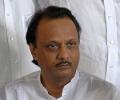
Maharashtra government on Saturday gave a clean chit to Deputy Chief Minister Ajit Pawar in the irrigation scam as it tabled in the Legislative Assembly the report of Madhav Chitale committee on the issue alongwith the Action Taken Report.

'Understand one thing, if you want immediately and magically that things should become cheap, it's not possible. It's a long-term policy.' 'Inflation is linked to the storage system and with the production system. Whenever production rises, prices go lower. So if we store when the prices are low and release them when prices rise, prices can be maintained.' 'The problem is that in our country fruits and vegetables worth Rs 110,000 crore go to waste as they rot. And grains worth Rs 85,000 crore rot. So the storage system is another big reason for inflation.' Union Transport Minister Nitin Gadkari in an exclusive interaction with Sheela Bhatt/Rediff.com

The success of the government will depend substantially on the quality of its team of key ministers, officials and advisors
.jpg)
'Mining jobs get created in the most backward districts of India's poorest states,' says Anil Agarwal.

Former Watson Fellow and social entrepreneur Srikar Gullapalli talks about the issues affecting India's growth and tells us why he wants more people to actively participate in building a bright future and put India on the global map.

'Those who have seen the functioning of the Modi government in Gujarat know that the issues related to Hindutva and issues of economy and growth function simultaneously.' 'Modi's politics are based on the understanding of the middle-class consumer society which is in pursuit of material aspirations.' Sheela Bhatt/Rediff.com reveals the Modi government's economic and political plans for the year ahead.
 © 2026 Rediff.com - Advertise with us - Disclaimer - Privacy Policy - Sitemap - Feedback - About us - Terms of use - Grievances